Toronto is planning one of its most ambitious developments ever: nine towers and nearly 8,000 condo units built over the downtown rail corridor from Bathurst to Blue Jays Way. What started as a dream for a 20-acre urban park has turned into a high-density residential project with only potential park space and a $6.5 billion price tag. The question is whether it actually solves any of Toronto's real problems, or just creates new ones.
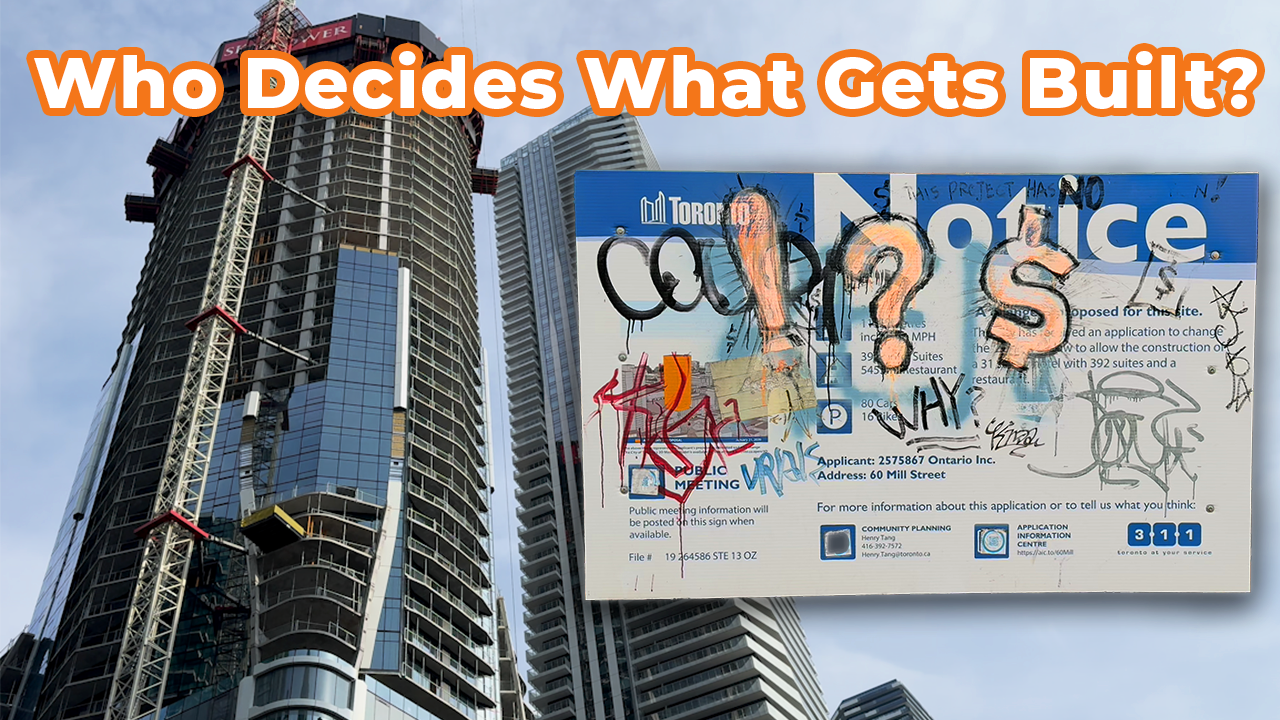
In 2016, Toronto envisioned a massive urban park over the downtown rail corridor. But when the landowners, LiUNA: the Laborers' International Union of North America, submitted a mixed-use development application instead, everything changed. City Council rejected it, the landowners appealed to the Ontario Land Tribunal, and the OLT sided with the developers. Now, the plan is nine towers across three blocks (West, Centre, and East) with heights ranging from 36 to 72 storeys, delivering 7,986 residential units, 150,000 square feet of retail, three daycares, and 8.62 acres labeled as potential park space.
The project is being advised by Fengate, though they currently hold no equity and have limited Toronto development experience. Construction over active rail tracks means work can only happen between midnight and 5 a.m. on weekdays, which translates to years, possibly over a decade, of nighttime noise and disruption. The development is being marketed as transit-oriented, tied to a new GO Station at Front and Spadina. The station will serve the Barrie line, which already stops at Union Station just one kilometer away. While it might shave a few minutes off your walk to Union, it won't meaningfully benefit residents of these new condos, it's designed for commuters traveling into downtown, not people already living there. Calling this "transit-oriented" is a stretch when the time savings are minimal.
This project represents a massive transformation of downtown Toronto, but it raises serious questions about who it's actually serving. Seventy-four percent of the units are studios and one-bedrooms, averaging just 516 square feet, the exact type of shoebox condos currently sitting vacant in record numbers. Meanwhile, two-bedroom units average 713 square feet and three-bedrooms just 867 square feet, far too small for the families the developers claim to be accommodating with daycares built into each block.
The promised park space is labeled potential, meaning there's no guarantee it will ever be built. What's likely is hardscaped lots sitting empty for years, or at best, concrete plazas with no trees, sports fields, or functional green space. Ontario legislation limits what the city can demand: just 15 percent parkland contribution and a 4 percent Community Benefits Charge, down from the 10 to 15 percent developers used to negotiate under the old Section 37 framework. That means fewer schools, community centers, and amenities to support the thousands of new residents this project will bring.
And then there's the financial reality. At $6.5 billion, or roughly $800,000 per unit before park space or amenities, this project doesn't pencil out without massive public subsidies or sky-high condo prices. If it fails to deliver, taxpayers will be left covering the gaps.
This project makes no sense. It's not that I just dislike it, it's fundamentally a bad proposal that offers zero civic gain. The park is imaginary, relying on subsidies that don't exist. The developer needs the city to hand over a portion of Front Street just to make their current vision work. And even if that happens, you're left with small, investor-focused units that don't address Toronto's actual housing needs and a concrete slab where a park was supposed to be.
Let's talk about the units. Fengate's justification for building 74 percent studios and one-bedrooms is that they want to create affordable housing by total price point. That logic is completely backwards. It's like a grocery store only selling bread because it's the cheapest item, while eggs and milk become unaffordable due to short supply. We have a record number of vacant condos right now, shoebox units sitting empty because they're too small to live in. So why are we building thousands more of them?
They're putting daycares in the building, which tells you they want families. But show me the family that wants to raise kids in a 700-square-foot two-bedroom or an 867-square-foot three-bedroom. These units are designed for investors, not end-users. And if rental demand shifts, especially with recent immigration policy changes, these units will sit vacant just like the rest.
And let's be honest about the broader implications. Building over active rail tracks is incredibly complex and expensive. Hudson Yards in New York cost over $20 billion. Millennium Park in Chicago went from $150 million to nearly $500 million. At $6.5 billion for this project, the math doesn't work without public money or unit prices so high that average buyers are priced out entirely. And if Toronto's maintenance of the Gardiner Expressway is any indication, we're not great at keeping elevated concrete infrastructure in good shape.
And for community services they’re only providing daycares, which doesn't really make up for the influx in residents they are going to bring. CityPlace’s Canoe Landing Community Centre and school are already at capacity, and this development will only make that worse.
This isn't a solution to Toronto's housing crisis, despite what the development's representatives claim. It's building more of the same units we already have too many of, while ignoring the larger, family-sized housing people actually need.
Here's the bottom line: this project is unambitious, offers no meaningful city-building, and relies entirely on public subsidies it hasn't secured. It's a work of fiction, not a viable plan. I'd put it in the same category as Google's Sidewalk Labs smart city proposal, bold on paper, dead on arrival in reality. Toronto deserves better than this.