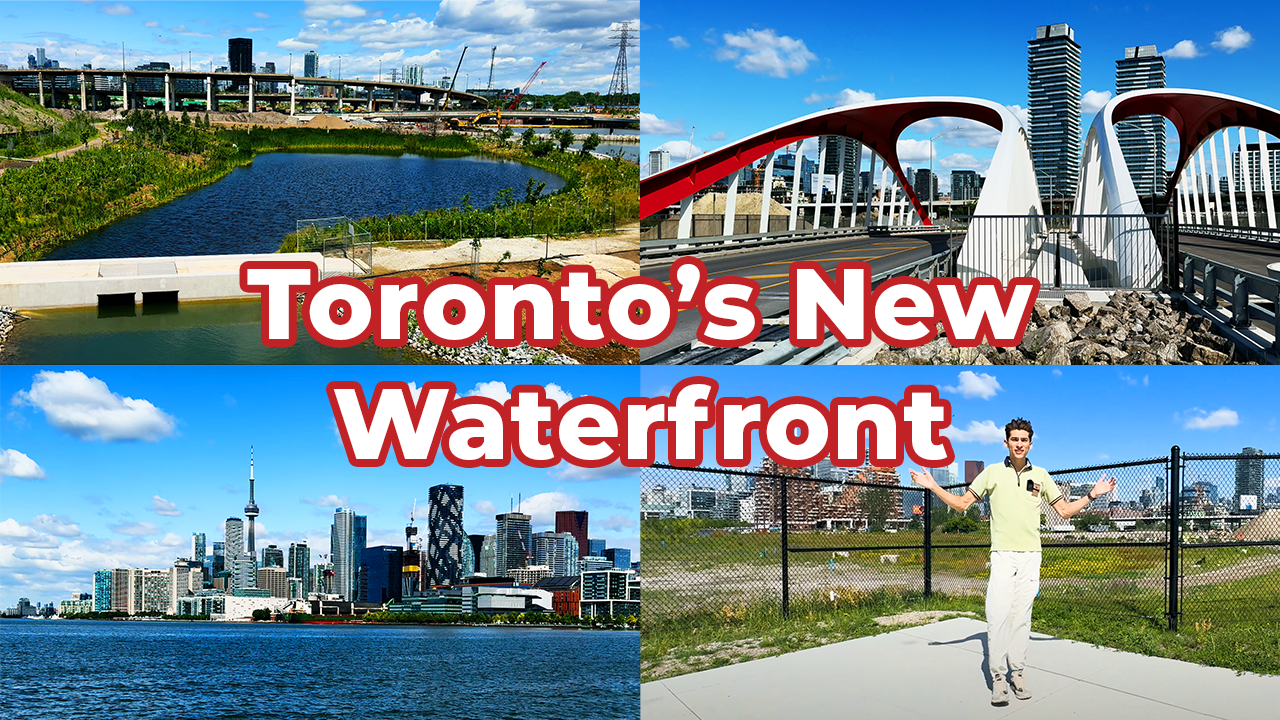
Toronto has already proven it can build complete communities, neighbourhoods where housing, parks, schools, childcare, and daily essentials are planned as one system instead of bolted on later. St. Lawrence (along The Esplanade) and the Canary District in the West Don Lands were built decades apart, but they share the same core idea: plan the neighbourhood first, then build the pieces to fit.So here’s the question: why don’t we build more neighbourhoods like this when the opportunity arises? We have new blank-canvas sites coming (the Port Lands, Downsview, and new Ontario Line station areas) and we still aren’t planning them with the same neighbourhood-first discipline.
Most of Toronto doesn’t become a neighbourhood all at once. A site gets developed, then the lot next door, then another across the street, each with different developers, timelines, priorities, and design approaches. The result is often a place with plenty of units, but one that feels incomplete in real life: not enough parks, no school yet, no community hub, retail that doesn’t serve residents, and public space that reads as an afterthought.
But it doesn’t have to be like this. Toronto already has proof-of-concept neighbourhoods where the plan came first and the buildings followed. These are places that feel complete because the public realm and community infrastructure were designed into the project from the start.
In St. Lawrence along the Esplanade (1970s–80s), a large, messy post-industrial area south of Front Street was planned as a full district instead of being redeveloped parcel by parcel. The City leaned into European-influenced urbanism and built a mix of co-op, social, and market housing around a real “spine” of public space (David Crombie Park), pairing it with early community infrastructure like a school, library, childcare, a community centre, and retail.
The Canary District in the West Don Lands (2010s) followed the same neighbourhood-first logic in a totally different era. After decades of sitting empty due to floodplain risk and contamination, the area only became developable once flood protection and remediation unlocked it. The Pan Am Athletes’ Village accelerated coordinated delivery of housing, streets, and parks, anchored by Corktown Common (a major park and flood-protection asset) that opened early, followed by amenities like the YMCA as the community filled in.
Both are the product of one thing Toronto rarely gets: one big, connected piece of land with enough coordination to design a neighbourhood as a single project.
If you care about affordability or livability, this matters because Toronto can hit big housing targets and still fall short in day-to-day life. When schools, parks, childcare, and main streets don’t arrive alongside the housing, the area isn’t pleasant to live in.
Toronto has already delivered complete communities when the land was assembled and the plan came first. The failure is that we’ve either forgotten how to do it, or we simply don’t care.
What St. Lawrence gets right is: it treats public space and community infrastructure as the starting point, not the reward you earn after enough condos are built. David Crombie Park is not a decorative park built to check a box off, it is the backbone of the community. And the neighbourhood includes a mix of co-op, social, and market housing.
Canary is the modern proof this isn’t just some 1970s planning fairy tale. The West Don Lands was a mess of constraints, floodplain risk, contamination, and industrial wasteland, and then the city did the unglamorous work (flood protection, remediation) and the place finally clicked into a real neighbourhood. Corktown Common opening early was a major draw, because it made the neighbourhood feel livable right away. The YMCA arriving quickly mattered for the same reason, it gave residents a real community anchor early on.
Now compare that to how we’re approaching today’s blank canvases. Some of what we’re seeing in places like Ookwemin Minising or major transit station-area proposals feels like the bad Toronto habit: maximize towers, squeeze unit sizes, and hope the city can stitch together the rest later. That’s not a plan, that’s outsourcing urbanism to whatever survives value engineering. And it’s all being done in the name of housing affordability. I’ve yet to be shown how these empty, unliveable condo units are helping people afford a home.
I do understand the pressure. Governments need projects to be financially viable and developers want to maximize land value. But if the only lever we pull is “more units per hectare,” we’re going to keep building neighbourhoods where residents move in and wait a decade for the basics. That’s not solving any crisis, it’s just relocating it into parks deficits, overcrowded schools, and poor livability.
Toronto already has the blueprint. The question is whether the city is willing to follow it the next time we get a rare chance.